> ## Documentation Index
> Fetch the complete documentation index at: https://docs.portkey.ai/docs/llms.txt
> Use this file to discover all available pages before exploring further.
# OpenAI
> Integrate OpenAI's GPT models with Portkey's AI Gateway
Portkey provides a robust and secure gateway to integrate [OpenAI's APIs](https://platform.openai.com/docs/api-reference/introduction) into your applications, including GPT-4o, o1, DALL·E, Whisper, and more.
With Portkey, take advantage of features like fast AI gateway access, observability, prompt management, and more, while securely managing API keys through [Model Catalog](/product/model-catalog).
Full support for GPT-4o, o1, GPT-4, GPT-3.5, and all OpenAI models
Chat, completions, embeddings, audio, images, and more fully supported
Use with OpenAI SDK, Portkey SDK, or popular frameworks like LangChain
## Quick Start
Get OpenAI working in 3 steps:
```python Python icon="python" theme={"system"}
from portkey_ai import Portkey
# 1. Install: pip install portkey-ai
# 2. Add @openai provider in model catalog
# 3. Use it:
portkey = Portkey(api_key="PORTKEY_API_KEY")
response = portkey.chat.completions.create(
model="@openai/gpt-4o",
messages=[{"role": "user", "content": "Say this is a test"}]
)
print(response.choices[0].message.content)
```
```js Javascript icon="square-js" theme={"system"}
import Portkey from 'portkey-ai'
// 1. Install: npm install portkey-ai
// 2. Add @openai provider in model catalog
// 3. Use it:
const portkey = new Portkey({
apiKey: "PORTKEY_API_KEY"
})
const response = await portkey.chat.completions.create({
model: "@openai/gpt-4o",
messages: [{ role: "user", content: "Say this is a test" }]
})
console.log(response.choices[0].message.content)
```
```python OpenAI Py icon="python" theme={"system"}
from openai import OpenAI
from portkey_ai import PORTKEY_GATEWAY_URL
# 1. Install: pip install openai portkey-ai
# 2. Add @openai provider in model catalog
# 3. Use it:
client = OpenAI(
api_key="PORTKEY_API_KEY", # Portkey API key
base_url=PORTKEY_GATEWAY_URL
)
response = client.chat.completions.create(
model="@openai/gpt-4o",
messages=[{"role": "user", "content": "Say this is a test"}]
)
print(response.choices[0].message.content)
```
```js OpenAI JS icon="square-js" theme={"system"}
import OpenAI from "openai"
import { PORTKEY_GATEWAY_URL } from "portkey-ai"
// 1. Install: npm install openai portkey-ai
// 2. Add @openai provider in model catalog
// 3. Use it:
const client = new OpenAI({
apiKey: "PORTKEY_API_KEY", // Portkey API key
baseURL: PORTKEY_GATEWAY_URL
})
const response = await client.chat.completions.create({
model: "@openai/gpt-4o",
messages: [{ role: "user", content: "Say this is a test" }]
})
console.log(response.choices[0].message.content)
```
```sh cURL icon="square-terminal" theme={"system"}
# 1. Add @openai provider in model catalog
# 2. Use it:
curl https://api.portkey.ai/v1/chat/completions \
-H "Content-Type: application/json" \
-H "x-portkey-api-key: $PORTKEY_API_KEY" \
-H "x-portkey-provider: @openai" \
-d '{
"model": "gpt-4o",
"messages": [
{ "role": "user", "content": "Say this is a test" }
]
}'
```
**Tip:** You can also set `provider="@openai"` in `Portkey()` and use just `model="gpt-4o"` in the request.
**Legacy support:** The `virtual_key` parameter still works for backwards compatibility.
## Add Provider in Model Catalog
1. Go to [**Model Catalog → Add Provider**](https://app.portkey.ai/model-catalog/providers)
2. Select **OpenAI**
3. Choose existing credentials or create new by entering your [OpenAI API key](https://platform.openai.com/api-keys)
4. (Optional) Add your OpenAI **Organization ID** and **Project ID** for better cost tracking
5. Name your provider (e.g., `openai-prod`)
See all setup options, code examples, and detailed instructions
## Basic Usage
### Streaming
Stream responses for real-time output in your applications:
```python Python icon="python" theme={"system"}
response = portkey.chat.completions.create(
model="@openai/gpt-4o",
messages=[{"role": "user", "content": "Tell me a story"}],
stream=True
)
for chunk in response:
if chunk.choices[0].delta.content:
print(chunk.choices[0].delta.content, end="", flush=True)
```
```js Javascript icon="square-js" theme={"system"}
const response = await portkey.chat.completions.create({
model: "@openai/gpt-4o",
messages: [{ role: "user", content: "Tell me a story" }],
stream: true
})
for await (const chunk of response) {
if (chunk.choices[0]?.delta?.content) {
process.stdout.write(chunk.choices[0].delta.content)
}
}
```
## Advanced Features
### Responses API
OpenAI's Responses API combines the best of both Chat Completions and Assistants APIs. Portkey fully supports this API with both the Portkey SDK and OpenAI SDK.
```python Python icon="python" theme={"system"}
from portkey_ai import Portkey
portkey = Portkey(api_key="PORTKEY_API_KEY")
response = portkey.responses.create(
model="@openai/gpt-4.1",
input="Tell me a three sentence bedtime story about a unicorn."
)
print(response)
```
```js Javascript icon="square-js" theme={"system"}
import Portkey from 'portkey-ai'
const portkey = new Portkey({
apiKey: "PORTKEY_API_KEY"
})
const response = await portkey.responses.create({
model: "@openai/gpt-4.1",
input: "Tell me a three sentence bedtime story about a unicorn."
})
console.log(response)
```
```python OpenAI Py icon="python" theme={"system"}
from openai import OpenAI
from portkey_ai import PORTKEY_GATEWAY_URL
client = OpenAI(
api_key="PORTKEY_API_KEY",
base_url=PORTKEY_GATEWAY_URL
)
response = client.responses.create(
model="@openai/gpt-4.1",
input="Tell me a three sentence bedtime story about a unicorn."
)
print(response)
```
```js OpenAI JS icon="square-js" theme={"system"}
import OpenAI from 'openai'
import { PORTKEY_GATEWAY_URL } from 'portkey-ai'
const openai = new OpenAI({
apiKey: "PORTKEY_API_KEY",
baseURL: PORTKEY_GATEWAY_URL
})
const response = await openai.responses.create({
model: "@openai/gpt-4.1",
input: "Tell me a three sentence bedtime story about a unicorn."
})
console.log(response)
```
The Responses API provides a more flexible foundation for building agentic applications with built-in tools that execute automatically.
Portkey supports Remote MCP support by OpenAI on its Responses API. Learn More
#### Streaming with Responses API
```python Python icon="python" theme={"system"}
response = portkey.responses.create(
model="@openai/gpt-4.1",
instructions="You are a helpful assistant.",
input="Hello!",
stream=True
)
for event in response:
print(event)
```
```js Javascript icon="square-js" theme={"system"}
const response = await portkey.responses.create({
model: "@openai/gpt-4.1",
instructions: "You are a helpful assistant.",
input: "Hello!",
stream: true
})
for await (const event of response) {
console.log(event)
}
```
```python OpenAI Py icon="python" theme={"system"}
response = client.responses.create(
model="gpt-4.1",
instructions="You are a helpful assistant.",
input="Hello!",
stream=True
)
for event in response:
print(event)
```
```js OpenAI JS icon="square-js" theme={"system"}
const response = await openai.responses.create({
model: "gpt-4.1",
instructions: "You are a helpful assistant.",
input: "Hello!",
stream: true
})
for await (const event of response) {
console.log(event)
}
```
### Realtime API
Portkey supports OpenAI's Realtime API with a seamless integration. This allows you to use Portkey's logging, cost tracking, and guardrail features while using the Realtime API.
### Using Vision Models
Portkey's multimodal Gateway fully supports OpenAI vision models as well. See this guide for more info:
[Vision](/product/ai-gateway/multimodal-capabilities/vision)
#### Vision with the Responses API
The Responses API also processes images alongside text:
```python Python icon="python" theme={"system"}
response = portkey.responses.create(
model="@openai/gpt-4.1",
input=[
{
"role": "user",
"content": [
{ "type": "input_text", "text": "What is in this image?" },
{
"type": "input_image",
"image_url": "https://upload.wikimedia.org/wikipedia/commons/thumb/d/dd/Gfp-wisconsin-madison-the-nature-boardwalk.jpg/2560px-Gfp-wisconsin-madison-the-nature-boardwalk.jpg"
}
]
}
]
)
print(response)
```
```js Javascript icon="square-js" theme={"system"}
const response = await portkey.responses.create({
model: "@openai/gpt-4.1",
input: [
{
role: "user",
content: [
{ type: "input_text", text: "What is in this image?" },
{
type: "input_image",
image_url: "https://upload.wikimedia.org/wikipedia/commons/thumb/d/dd/Gfp-wisconsin-madison-the-nature-boardwalk.jpg/2560px-Gfp-wisconsin-madison-the-nature-boardwalk.jpg"
}
]
}
]
})
console.log(response)
```
```python OpenAI Py icon="python" theme={"system"}
response = client.responses.create(
model="gpt-4.1",
input=[
{
"role": "user",
"content": [
{ "type": "input_text", "text": "What is in this image?" },
{
"type": "input_image",
"image_url": "https://upload.wikimedia.org/wikipedia/commons/thumb/d/dd/Gfp-wisconsin-madison-the-nature-boardwalk.jpg/2560px-Gfp-wisconsin-madison-the-nature-boardwalk.jpg"
}
]
}
]
)
print(response)
```
```js OpenAI JS icon="square-js" theme={"system"}
const response = await openai.responses.create({
model: "gpt-4.1",
input: [
{
role: "user",
content: [
{ type: "input_text", text: "What is in this image?" },
{
type: "input_image",
image_url: "https://upload.wikimedia.org/wikipedia/commons/thumb/d/dd/Gfp-wisconsin-madison-the-nature-boardwalk.jpg/2560px-Gfp-wisconsin-madison-the-nature-boardwalk.jpg"
}
]
}
]
})
console.log(response)
```
### Function Calling
Function calls within your OpenAI or Portkey SDK operations remain standard. These logs will appear in Portkey, highlighting the utilized functions and their outputs.
Additionally, you can define functions within your prompts and invoke the `portkey.prompts.completions.create` method as above.
#### Function Calling with the Responses API
The Responses API also supports function calling with the same powerful capabilities:
```python Python icon="python" theme={"system"}
tools = [
{
"type": "function",
"name": "get_current_weather",
"description": "Get the current weather in a given location",
"parameters": {
"type": "object",
"properties": {
"location": {
"type": "string",
"description": "The city and state, e.g. San Francisco, CA"
},
"unit": {"type": "string", "enum": ["celsius", "fahrenheit"]}
},
"required": ["location", "unit"]
}
}
]
response = portkey.responses.create(
model="@openai/gpt-4.1",
tools=tools,
input="What is the weather like in Boston today?",
tool_choice="auto"
)
print(response)
```
```js Javascript icon="square-js" theme={"system"}
const tools = [
{
type: "function",
name: "get_current_weather",
description: "Get the current weather in a given location",
parameters: {
type: "object",
properties: {
location: {
type: "string",
description: "The city and state, e.g. San Francisco, CA"
},
unit: { type: "string", enum: ["celsius", "fahrenheit"] }
},
required: ["location", "unit"]
}
}
]
const response = await portkey.responses.create({
model: "@openai/gpt-4.1",
tools: tools,
input: "What is the weather like in Boston today?",
tool_choice: "auto"
})
console.log(response)
```
```python OpenAI Py icon="python" theme={"system"}
tools = [
{
"type": "function",
"name": "get_current_weather",
"description": "Get the current weather in a given location",
"parameters": {
"type": "object",
"properties": {
"location": {
"type": "string",
"description": "The city and state, e.g. San Francisco, CA"
},
"unit": {"type": "string", "enum": ["celsius", "fahrenheit"]}
},
"required": ["location", "unit"]
}
}
]
response = client.responses.create(
model="gpt-4.1",
tools=tools,
input="What is the weather like in Boston today?",
tool_choice="auto"
)
print(response)
```
```js OpenAI JS icon="square-js" theme={"system"}
const tools = [
{
type: "function",
name: "get_current_weather",
description: "Get the current weather in a given location",
parameters: {
type: "object",
properties: {
location: {
type: "string",
description: "The city and state, e.g. San Francisco, CA"
},
unit: { type: "string", enum: ["celsius", "fahrenheit"] }
},
required: ["location", "unit"]
}
}
]
const response = await openai.responses.create({
model: "gpt-4.1",
tools: tools,
input: "What is the weather like in Boston today?",
tool_choice: "auto"
})
console.log(response)
```
### Fine-Tuning
Please refer to our fine-tuning guides to take advantage of Portkey's advanced [continuous fine-tuning](/product/autonomous-fine-tuning) capabilities.
### Image Generation
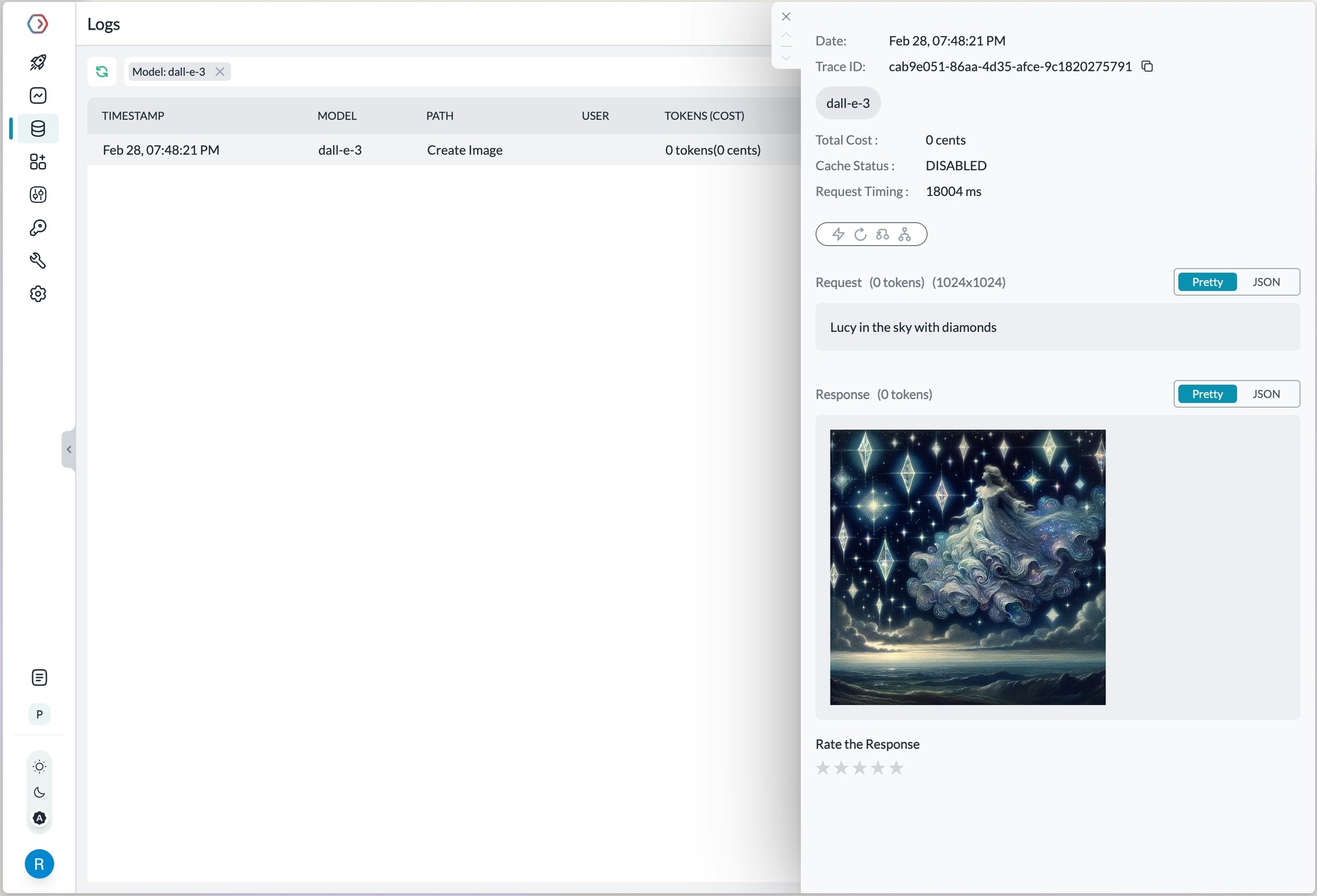
Portkey supports multiple modalities for OpenAI. Make image generation requests through Portkey's AI Gateway the same way as making completion calls.
```js Javascript icon="square-js" theme={"system"}
// Define the OpenAI client as shown above
const image = await openai.images.generate({
model:"dall-e-3",
prompt:"Lucy in the sky with diamonds",
size:"1024x1024"
})
```
```python Python icon="python" theme={"system"}
# Define the OpenAI client as shown above
image = openai.images.generate(
model="dall-e-3",
prompt="Lucy in the sky with diamonds",
size="1024x1024"
)
```
Portkey's fast AI gateway captures the information about the request on your Portkey Dashboard. On your logs screen, you'd be able to see this request with the request and response.
 More information on image generation is available in the [API Reference](/provider-endpoints/images/create-image#create-image).
### Video Generation with Sora
Portkey supports OpenAI's Sora video generation models through the AI Gateway. Generate videos using the Portkey Python SDK:
```python theme={"system"}
from portkey_ai import Portkey
client = Portkey(
api_key="PORTKEY_API_KEY"
)
video = client.videos.create(
model="@openai/sora-2",
prompt="A video of a cool cat on a motorcycle in the night",
)
print("Video generation started:", video)
```
Pricing for video generation requests will be visible on your Portkey dashboard, allowing you to track costs alongside your other API usage.
### Audio - Transcription, Translation, and Text-to-Speech
Portkey's multimodal Gateway also supports the `audio` methods on OpenAI API. Check out the below guides for more info:
Check out the below guides for more info:
[Text-to-Speech](/product/ai-gateway/multimodal-capabilities/text-to-speech)
[Speech-to-Text](/product/ai-gateway/multimodal-capabilities/speech-to-text)
***
## Integrated Tools with Responses API
### Web Search Tool
Web search delivers accurate and clearly-cited answers from the web, using the same tool as search in ChatGPT:
```python Python icon="python" theme={"system"}
response = portkey.responses.create(
model="@openai/gpt-4.1",
tools=[{
"type": "web_search_preview",
"search_context_size": "medium", # Options: "high", "medium" (default), or "low"
"user_location": { # Optional - for localized results
"type": "approximate",
"country": "US",
"city": "San Francisco",
"region": "California"
}
}],
input="What was a positive news story from today?"
)
print(response)
```
```js Javascript icon="square-js" theme={"system"}
const response = await portkey.responses.create({
model: "@openai/gpt-4.1",
tools: [{
type: "web_search_preview",
search_context_size: "medium", // Options: "high", "medium" (default), or "low"
user_location: { // Optional - for localized results
type: "approximate",
country: "US",
city: "San Francisco",
region: "California"
}
}],
input: "What was a positive news story from today?"
})
console.log(response)
```
**Options for `search_context_size`:**
* `high`: Most comprehensive context, higher cost, slower response
* `medium`: Balanced context, cost, and latency (default)
* `low`: Minimal context, lowest cost, fastest response
Responses include citations for URLs found in search results, with clickable references.
### File Search Tool
File search enables quick retrieval from your knowledge base across multiple file types:
```python Python icon="python" theme={"system"}
response = portkey.responses.create(
model="@openai/gpt-4.1",
tools=[{
"type": "file_search",
"vector_store_ids": ["vs_1234567890"],
"max_num_results": 20,
"filters": { # Optional - filter by metadata
"type": "eq",
"key": "document_type",
"value": "report"
}
}],
input="What are the attributes of an ancient brown dragon?"
)
print(response)
```
```js Javascript icon="square-js" theme={"system"}
const response = await portkey.responses.create({
model: "@openai/gpt-4.1",
tools: [{
type: "file_search",
vector_store_ids: ["vs_1234567890"],
max_num_results: 20,
filters: { // Optional - filter by metadata
type: "eq",
key: "document_type",
value: "report"
}
}],
input: "What are the attributes of an ancient brown dragon?"
})
console.log(response)
```
This tool requires you to first create a vector store and upload files to it. Supports various file formats including PDFs, DOCXs, TXT, and more. Results include file citations in the response.
### Enhanced Reasoning
Control the depth of model reasoning for more comprehensive analysis:
```python Python icon="python" theme={"system"}
response = portkey.responses.create(
model="@openai/o3-mini",
input="How much wood would a woodchuck chuck?",
reasoning={
"effort": "high" # Options: "high", "medium", or "low"
}
)
print(response)
```
```js Javascript icon="square-js" theme={"system"}
const response = await portkey.responses.create({
model: "@openai/o3-mini",
input: "How much wood would a woodchuck chuck?",
reasoning: {
effort: "high" // Options: "high", "medium", or "low"
}
})
console.log(response)
```
### Computer Use Assistant
Portkey also supports the Computer Use Assistant (CUA) tool, which helps agents control computers or virtual machines through screenshots and actions. This feature is available for select developers as a research preview on premium tiers.
Learn More about Computer use tool here
## Managing OpenAI Projects & Organizations in Portkey
When integrating OpenAI with Portkey, specify your OpenAI organization and project IDs along with your API key. This is particularly useful if you belong to multiple organizations or are accessing projects through a legacy user API key.
Specifying the organization and project IDs helps you maintain better control over your access rules, usage, and costs.
Add your Org & Project details using:
1. Adding in Model Catalog (Recommended)
2. Defining a Gateway Config
3. Passing Details in a Request
Let's explore each method in more detail.
### Using Model Catalog
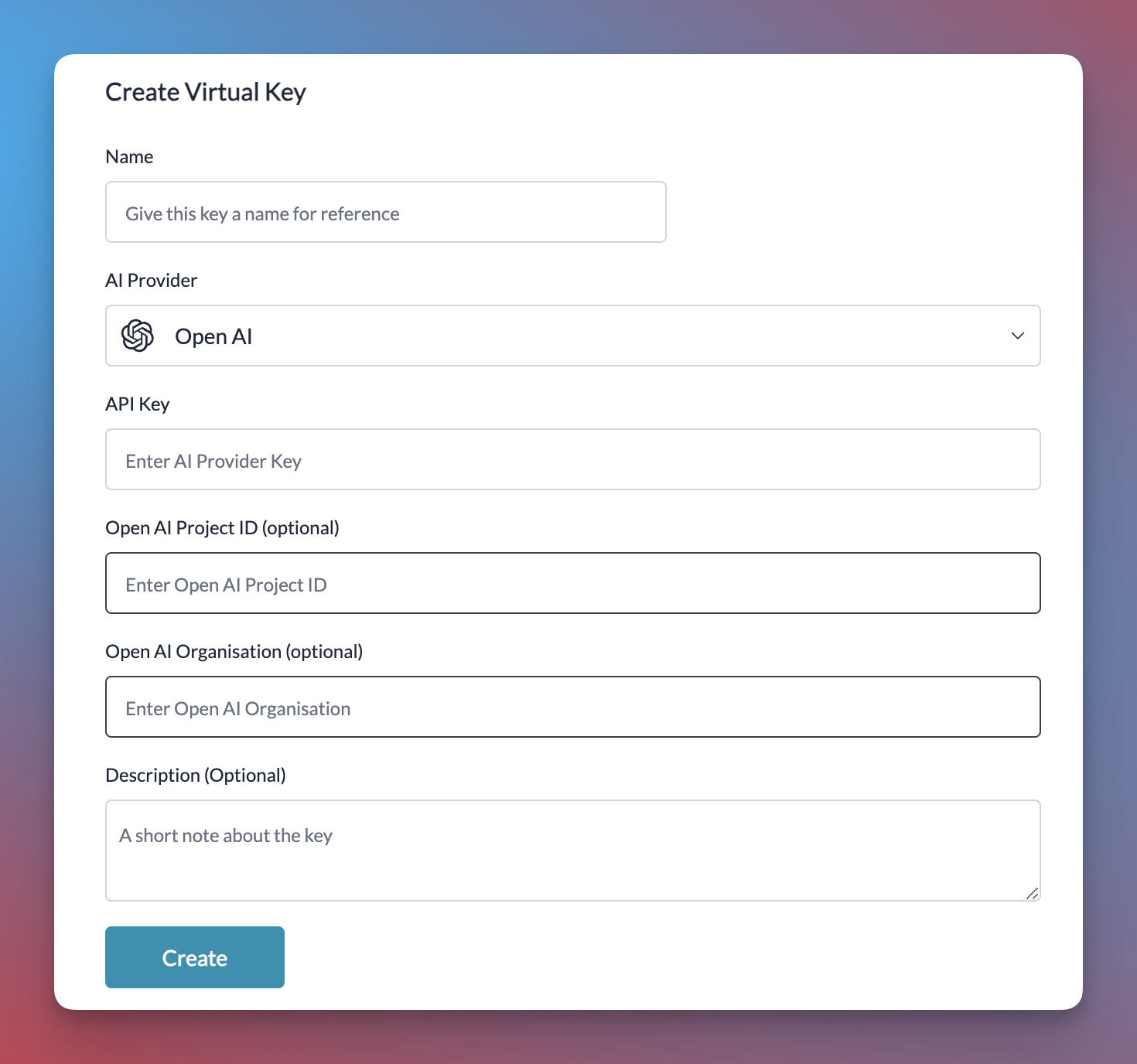
When adding OpenAI from the Model Catalog, Portkey automatically displays optional fields for the organization ID and project ID alongside the API key field.
[Get your OpenAI API key from here](https://platform.openai.com/api-keys), then add it to Portkey along with your org/project details.
More information on image generation is available in the [API Reference](/provider-endpoints/images/create-image#create-image).
### Video Generation with Sora
Portkey supports OpenAI's Sora video generation models through the AI Gateway. Generate videos using the Portkey Python SDK:
```python theme={"system"}
from portkey_ai import Portkey
client = Portkey(
api_key="PORTKEY_API_KEY"
)
video = client.videos.create(
model="@openai/sora-2",
prompt="A video of a cool cat on a motorcycle in the night",
)
print("Video generation started:", video)
```
Pricing for video generation requests will be visible on your Portkey dashboard, allowing you to track costs alongside your other API usage.
### Audio - Transcription, Translation, and Text-to-Speech
Portkey's multimodal Gateway also supports the `audio` methods on OpenAI API. Check out the below guides for more info:
Check out the below guides for more info:
[Text-to-Speech](/product/ai-gateway/multimodal-capabilities/text-to-speech)
[Speech-to-Text](/product/ai-gateway/multimodal-capabilities/speech-to-text)
***
## Integrated Tools with Responses API
### Web Search Tool
Web search delivers accurate and clearly-cited answers from the web, using the same tool as search in ChatGPT:
```python Python icon="python" theme={"system"}
response = portkey.responses.create(
model="@openai/gpt-4.1",
tools=[{
"type": "web_search_preview",
"search_context_size": "medium", # Options: "high", "medium" (default), or "low"
"user_location": { # Optional - for localized results
"type": "approximate",
"country": "US",
"city": "San Francisco",
"region": "California"
}
}],
input="What was a positive news story from today?"
)
print(response)
```
```js Javascript icon="square-js" theme={"system"}
const response = await portkey.responses.create({
model: "@openai/gpt-4.1",
tools: [{
type: "web_search_preview",
search_context_size: "medium", // Options: "high", "medium" (default), or "low"
user_location: { // Optional - for localized results
type: "approximate",
country: "US",
city: "San Francisco",
region: "California"
}
}],
input: "What was a positive news story from today?"
})
console.log(response)
```
**Options for `search_context_size`:**
* `high`: Most comprehensive context, higher cost, slower response
* `medium`: Balanced context, cost, and latency (default)
* `low`: Minimal context, lowest cost, fastest response
Responses include citations for URLs found in search results, with clickable references.
### File Search Tool
File search enables quick retrieval from your knowledge base across multiple file types:
```python Python icon="python" theme={"system"}
response = portkey.responses.create(
model="@openai/gpt-4.1",
tools=[{
"type": "file_search",
"vector_store_ids": ["vs_1234567890"],
"max_num_results": 20,
"filters": { # Optional - filter by metadata
"type": "eq",
"key": "document_type",
"value": "report"
}
}],
input="What are the attributes of an ancient brown dragon?"
)
print(response)
```
```js Javascript icon="square-js" theme={"system"}
const response = await portkey.responses.create({
model: "@openai/gpt-4.1",
tools: [{
type: "file_search",
vector_store_ids: ["vs_1234567890"],
max_num_results: 20,
filters: { // Optional - filter by metadata
type: "eq",
key: "document_type",
value: "report"
}
}],
input: "What are the attributes of an ancient brown dragon?"
})
console.log(response)
```
This tool requires you to first create a vector store and upload files to it. Supports various file formats including PDFs, DOCXs, TXT, and more. Results include file citations in the response.
### Enhanced Reasoning
Control the depth of model reasoning for more comprehensive analysis:
```python Python icon="python" theme={"system"}
response = portkey.responses.create(
model="@openai/o3-mini",
input="How much wood would a woodchuck chuck?",
reasoning={
"effort": "high" # Options: "high", "medium", or "low"
}
)
print(response)
```
```js Javascript icon="square-js" theme={"system"}
const response = await portkey.responses.create({
model: "@openai/o3-mini",
input: "How much wood would a woodchuck chuck?",
reasoning: {
effort: "high" // Options: "high", "medium", or "low"
}
})
console.log(response)
```
### Computer Use Assistant
Portkey also supports the Computer Use Assistant (CUA) tool, which helps agents control computers or virtual machines through screenshots and actions. This feature is available for select developers as a research preview on premium tiers.
Learn More about Computer use tool here
## Managing OpenAI Projects & Organizations in Portkey
When integrating OpenAI with Portkey, specify your OpenAI organization and project IDs along with your API key. This is particularly useful if you belong to multiple organizations or are accessing projects through a legacy user API key.
Specifying the organization and project IDs helps you maintain better control over your access rules, usage, and costs.
Add your Org & Project details using:
1. Adding in Model Catalog (Recommended)
2. Defining a Gateway Config
3. Passing Details in a Request
Let's explore each method in more detail.
### Using Model Catalog
When adding OpenAI from the Model Catalog, Portkey automatically displays optional fields for the organization ID and project ID alongside the API key field.
[Get your OpenAI API key from here](https://platform.openai.com/api-keys), then add it to Portkey along with your org/project details.
 [Model Catalog](/product/model-catalog)
Portkey takes budget management a step further than OpenAI. While OpenAI allows setting budget limits per project, Portkey enables you to set budget limits for each provider you create. For more information on budget limits, refer to this documentation:
[Budget Limits](/product/ai-gateway/virtual-keys/budget-limits)
### Using the Gateway Config
You can also specify the organization and project details in the gateway config, either at the root level or within a specific target.
```json theme={"system"}
{
"provider": "@openai",
"openai_organization": "org-xxxxxx",
"openai_project": "proj_xxxxxxxx"
}
```
### While Making a Request
You can also pass your organization and project details directly when making a request using curl, the OpenAI SDK, or the Portkey SDK.
```python OpenAI Py icon="python" theme={"system"}
from openai import OpenAI
from portkey_ai import PORTKEY_GATEWAY_URL
client = OpenAI(
api_key="PORTKEY_API_KEY",
organization="org-xxxxxxxxxx",
project="proj_xxxxxxxxx",
base_url=PORTKEY_GATEWAY_URL
)
chat_complete = client.chat.completions.create(
model="@openai/gpt-4o",
messages=[{"role": "user", "content": "Say this is a test"}],
)
print(chat_complete.choices[0].message.content)
```
```js OpenAI JS icon="square-js" theme={"system"}
import OpenAI from "openai"
import { PORTKEY_GATEWAY_URL } from "portkey-ai"
const openai = new OpenAI({
apiKey: "PORTKEY_API_KEY",
organization: "org-xxxxxx",
project: "proj_xxxxxxx",
baseURL: PORTKEY_GATEWAY_URL
})
async function main() {
const chatCompletion = await openai.chat.completions.create({
messages: [{ role: "user", content: "Say this is a test" }],
model: "@openai/gpt-4o",
})
console.log(chatCompletion.choices)
}
main()
```
```sh cURL icon="square-terminal" theme={"system"}
curl https://api.portkey.ai/v1/chat/completions \
-H "Content-Type: application/json" \
-H "Authorization: Bearer $OPENAI_API_KEY" \
-H "x-portkey-openai-organization: org-xxxxxxx" \
-H "x-portkey-openai-project: proj_xxxxxxx" \
-H "x-portkey-api-key: $PORTKEY_API_KEY" \
-H "x-portkey-provider: @openai" \
-d '{
"model": "gpt-4o",
"messages": [{"role": "user","content": "Hello!"}]
}'
```
```python Python icon="python" theme={"system"}
from portkey_ai import Portkey
portkey = Portkey(
api_key="PORTKEY_API_KEY",
Authorization="Bearer OPENAI_API_KEY",
openai_organization="org-xxxxxxxxx",
openai_project="proj_xxxxxxxxx",
)
chat_complete = portkey.chat.completions.create(
model="@openai/gpt-4o",
messages=[{"role": "user", "content": "Say this is a test"}],
)
print(chat_complete.choices[0].message.content)
```
```js Javascript icon="square-js" theme={"system"}
import Portkey from "portkey-ai"
const portkey = new Portkey({
apiKey: "PORTKEY_API_KEY",
Authorization: "Bearer OPENAI_API_KEY",
openaiOrganization: "org-xxxxxxxxxxx",
openaiProject: "proj_xxxxxxxxxxxxx",
})
async function main() {
const chatCompletion = await portkey.chat.completions.create({
messages: [{ role: "user", content: "Say this is a test" }],
model: "@openai/gpt-4o",
})
console.log(chatCompletion.choices)
}
main()
```
***
## Frequently Asked Questions
### General FAQs
You can sign up to OpenAI [here](https://platform.openai.com/docs/overview) and grab your scoped API key [here](https://platform.openai.com/api-keys).
The OpenAI API can be used by signing up to the OpenAI platform. You can find the pricing info [here](https://openai.com/api/pricing/)
You can find your current rate limits imposed by OpenAI [here](https://platform.openai.com/settings/organization/limits). For more tips, check out [this guide](/guides/getting-started/tackling-rate-limiting).
[Model Catalog](/product/model-catalog)
Portkey takes budget management a step further than OpenAI. While OpenAI allows setting budget limits per project, Portkey enables you to set budget limits for each provider you create. For more information on budget limits, refer to this documentation:
[Budget Limits](/product/ai-gateway/virtual-keys/budget-limits)
### Using the Gateway Config
You can also specify the organization and project details in the gateway config, either at the root level or within a specific target.
```json theme={"system"}
{
"provider": "@openai",
"openai_organization": "org-xxxxxx",
"openai_project": "proj_xxxxxxxx"
}
```
### While Making a Request
You can also pass your organization and project details directly when making a request using curl, the OpenAI SDK, or the Portkey SDK.
```python OpenAI Py icon="python" theme={"system"}
from openai import OpenAI
from portkey_ai import PORTKEY_GATEWAY_URL
client = OpenAI(
api_key="PORTKEY_API_KEY",
organization="org-xxxxxxxxxx",
project="proj_xxxxxxxxx",
base_url=PORTKEY_GATEWAY_URL
)
chat_complete = client.chat.completions.create(
model="@openai/gpt-4o",
messages=[{"role": "user", "content": "Say this is a test"}],
)
print(chat_complete.choices[0].message.content)
```
```js OpenAI JS icon="square-js" theme={"system"}
import OpenAI from "openai"
import { PORTKEY_GATEWAY_URL } from "portkey-ai"
const openai = new OpenAI({
apiKey: "PORTKEY_API_KEY",
organization: "org-xxxxxx",
project: "proj_xxxxxxx",
baseURL: PORTKEY_GATEWAY_URL
})
async function main() {
const chatCompletion = await openai.chat.completions.create({
messages: [{ role: "user", content: "Say this is a test" }],
model: "@openai/gpt-4o",
})
console.log(chatCompletion.choices)
}
main()
```
```sh cURL icon="square-terminal" theme={"system"}
curl https://api.portkey.ai/v1/chat/completions \
-H "Content-Type: application/json" \
-H "Authorization: Bearer $OPENAI_API_KEY" \
-H "x-portkey-openai-organization: org-xxxxxxx" \
-H "x-portkey-openai-project: proj_xxxxxxx" \
-H "x-portkey-api-key: $PORTKEY_API_KEY" \
-H "x-portkey-provider: @openai" \
-d '{
"model": "gpt-4o",
"messages": [{"role": "user","content": "Hello!"}]
}'
```
```python Python icon="python" theme={"system"}
from portkey_ai import Portkey
portkey = Portkey(
api_key="PORTKEY_API_KEY",
Authorization="Bearer OPENAI_API_KEY",
openai_organization="org-xxxxxxxxx",
openai_project="proj_xxxxxxxxx",
)
chat_complete = portkey.chat.completions.create(
model="@openai/gpt-4o",
messages=[{"role": "user", "content": "Say this is a test"}],
)
print(chat_complete.choices[0].message.content)
```
```js Javascript icon="square-js" theme={"system"}
import Portkey from "portkey-ai"
const portkey = new Portkey({
apiKey: "PORTKEY_API_KEY",
Authorization: "Bearer OPENAI_API_KEY",
openaiOrganization: "org-xxxxxxxxxxx",
openaiProject: "proj_xxxxxxxxxxxxx",
})
async function main() {
const chatCompletion = await portkey.chat.completions.create({
messages: [{ role: "user", content: "Say this is a test" }],
model: "@openai/gpt-4o",
})
console.log(chatCompletion.choices)
}
main()
```
***
## Frequently Asked Questions
### General FAQs
You can sign up to OpenAI [here](https://platform.openai.com/docs/overview) and grab your scoped API key [here](https://platform.openai.com/api-keys).
The OpenAI API can be used by signing up to the OpenAI platform. You can find the pricing info [here](https://openai.com/api/pricing/)
You can find your current rate limits imposed by OpenAI [here](https://platform.openai.com/settings/organization/limits). For more tips, check out [this guide](/guides/getting-started/tackling-rate-limiting).