> ## Documentation Index
> Fetch the complete documentation index at: https://docs.portkey.ai/docs/llms.txt
> Use this file to discover all available pages before exploring further.
# Nomic
Portkey provides a robust and secure gateway to facilitate the integration of various Large Language Models (LLMs) into your applications, including [Nomic](https://docs.nomic.ai/reference/getting-started/).
Nomic has especially become popular due to it's superior embeddings and is now available through Portkey's AI gateway as well.
With Portkey, you can take advantage of features like fast AI gateway access, observability, prompt management, and more, all while ensuring the secure management of your LLM API keys through a [virtual key](/product/ai-gateway/virtual-keys) system.
Provider Slug. `nomic`
## Portkey SDK Integration with Nomic
Portkey provides a consistent API to interact with embedding models from various providers. To integrate Nomic with Portkey:
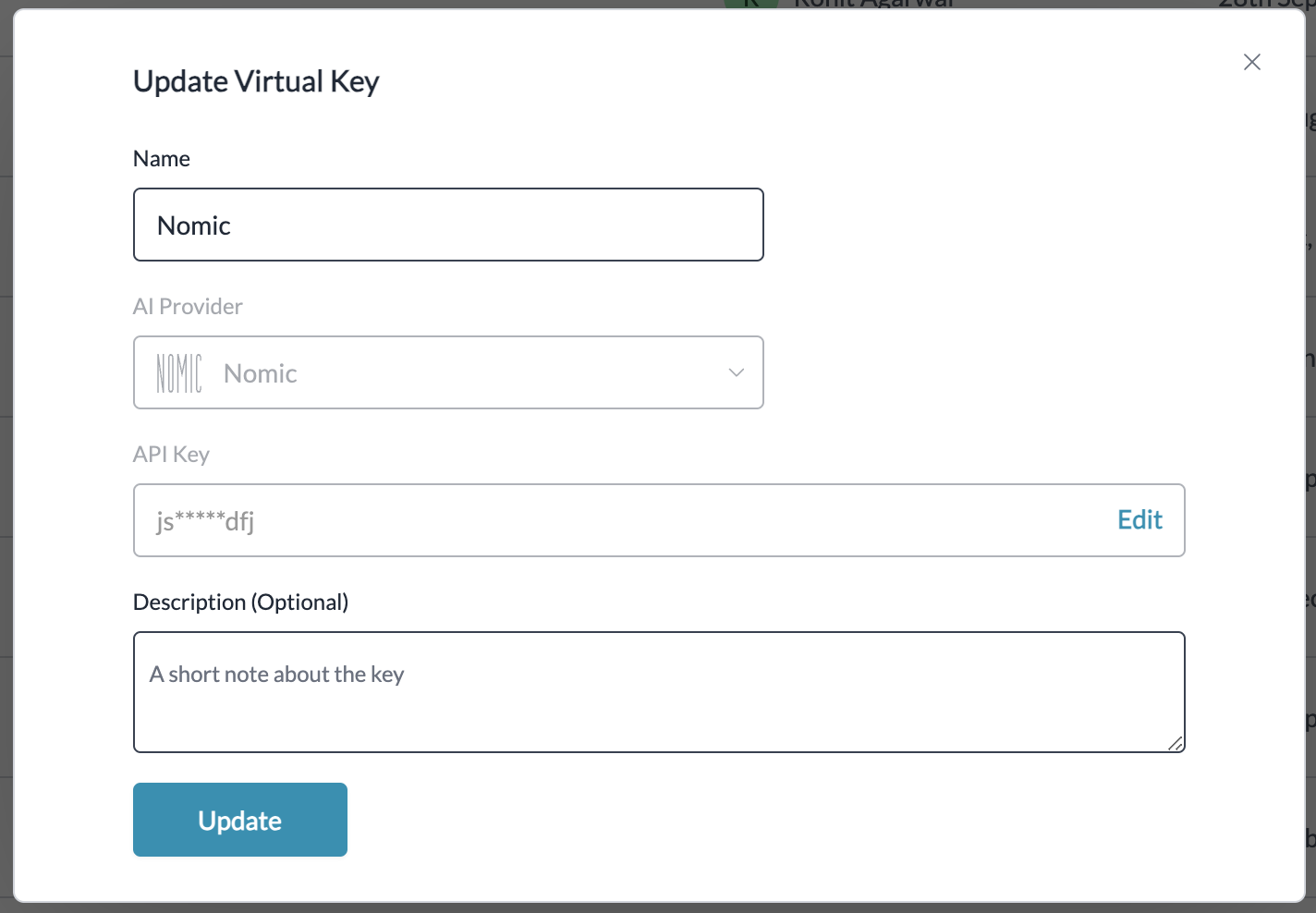
### 1. Create a Virtual Key for Nomic in your Portkey account
You can head over to the virtual keys tab and create one for Nomic. This will be then used to make API requests to Nomic without needing the protected API key. [Grab your Nomic API key from here](https://atlas.nomic.ai/).
 ### 2. Install the Portkey SDK and Initialize with this Virtual Key
Add the Portkey SDK to your application to interact with Nomic's API through Portkey's gateway.
```js theme={"system"}
import Portkey from 'portkey-ai'
const portkey = new Portkey({
apiKey: "PORTKEY_API_KEY", // defaults to process.env["PORTKEY_API_KEY"]
virtualKey: "VIRTUAL_KEY" // Your Nomic Virtual Key
})
```
```python theme={"system"}
from portkey_ai import Portkey
portkey = Portkey(
api_key="PORTKEY_API_KEY", # Replace with your Portkey API key
virtual_key="VIRTUAL_KEY" # Replace with your virtual key for Nomic
)
```
### 3. Invoke the Embeddings API with Nomic
Use the Portkey instance to send requests to your Nomic API. You can also override the virtual key directly in the API call if needed.
```js theme={"system"}
const embeddings = await portkey.embeddings.create({
input: "create vector representation on this sentence",
model: "nomic-embed-text-v1.5",
});
console.log(embeddings);
```
```python theme={"system"}
embeddings = portkey.embeddings.create(
input='create vector representation on this sentence',
model='nomic-embed-text-v1.5'
)
print(embeddings)
```
## Next Steps
The complete list of features supported in the SDK are available on the link below.
You'll find more information in the relevant sections:
1. [API Reference for Embeddings](/provider-endpoints/embeddings)
2. [Add metadata to your requests](/product/observability/metadata)
3. [Add gateway configs to your Nomic requests](/product/ai-gateway/configs)
4. [Tracing Nomic requests](/product/observability/traces)
### 2. Install the Portkey SDK and Initialize with this Virtual Key
Add the Portkey SDK to your application to interact with Nomic's API through Portkey's gateway.
```js theme={"system"}
import Portkey from 'portkey-ai'
const portkey = new Portkey({
apiKey: "PORTKEY_API_KEY", // defaults to process.env["PORTKEY_API_KEY"]
virtualKey: "VIRTUAL_KEY" // Your Nomic Virtual Key
})
```
```python theme={"system"}
from portkey_ai import Portkey
portkey = Portkey(
api_key="PORTKEY_API_KEY", # Replace with your Portkey API key
virtual_key="VIRTUAL_KEY" # Replace with your virtual key for Nomic
)
```
### 3. Invoke the Embeddings API with Nomic
Use the Portkey instance to send requests to your Nomic API. You can also override the virtual key directly in the API call if needed.
```js theme={"system"}
const embeddings = await portkey.embeddings.create({
input: "create vector representation on this sentence",
model: "nomic-embed-text-v1.5",
});
console.log(embeddings);
```
```python theme={"system"}
embeddings = portkey.embeddings.create(
input='create vector representation on this sentence',
model='nomic-embed-text-v1.5'
)
print(embeddings)
```
## Next Steps
The complete list of features supported in the SDK are available on the link below.
You'll find more information in the relevant sections:
1. [API Reference for Embeddings](/provider-endpoints/embeddings)
2. [Add metadata to your requests](/product/observability/metadata)
3. [Add gateway configs to your Nomic requests](/product/ai-gateway/configs)
4. [Tracing Nomic requests](/product/observability/traces)