About
Fontys ICT is a university of applied sciences in the Netherlands, where students, researchers, and teaching staff work on real-world ICT challenges.
Industry
AI Data Development
Headquarters
North America
Why Portkey:
AI governance, EU-first routing, budget enforcement, multi-provider, access and cost control


The challenge of AI adoption in higher education
As generative AI adoption accelerated, Fontys ICT observed a pattern common across higher education: AI usage expanded faster than institutional frameworks could adapt. Students, faculty, and researchers were already incorporating AI into coursework, experimentation, and research, but this usage sat largely outside formal infrastructure.
One of the earliest signals was unequal access. Advanced AI capabilities were increasingly gated behind personal subscriptions, creating disparities between students who could afford premium tools and those who could not. In an educational context, this directly conflicted with the principle of equal opportunity.
"We saw AI adaption growing very quickly with students and with staff, but it was all on personal devices, personal accounts, commercial subscriptions."
— Ruud Huijts, AI taskforce, Fontys ICT. Lecture, iCOP education innovation
The challenges of ungoverned AI usage
As AI became embedded in academic work, Fontys ICT started experiencing mounting operational and governance headaches.
Institutional visibility was difficult. AI tools were selected individually, APIs were integrated informally into assignments and projects, and data processing locations varied by provider. This made it difficult to understand where data was being processed, under which terms, and with what implications for privacy and GDPR compliance.
Cost control emerged as a structural challenge. With subscriptions and API usage distributed across personal accounts, reimbursements, and free tiers, the institution had no consolidated view of AI spend. Planning, forecasting, and assessing the educational value became nearly impossible.
There was also a pedagogical gap. Consumer-facing AI tools abstract away system behavior, model differences, and operational trade-offs. For an ICT-focused institution, this meant students were using powerful systems without visibility into how those systems are governed, evaluated, or integrated in professional environments.
Evaluating the options
The team evaluated several approaches common in higher education before designing their solution. Each offered partial relief, but none fully addressed the combination of equity, control, and adaptability required.
Institution-wide commercial subscriptions promised simplicity but were costly at scale, locked into single-vendor roadmaps, and offered limited data handling transparency.
Collective purchasing through organizations like SURF secured better prices but reduced flexibility and innovation capacity.
Self-hosting open-source models offered maximum sovereignty but diverted resources from education and risked isolating students from models they would encounter professionally.
None of these paths worked in isolation. What Fontys ICT needed was a way to get model diversity and institutional control in the same system.
The solution: AI Gateway
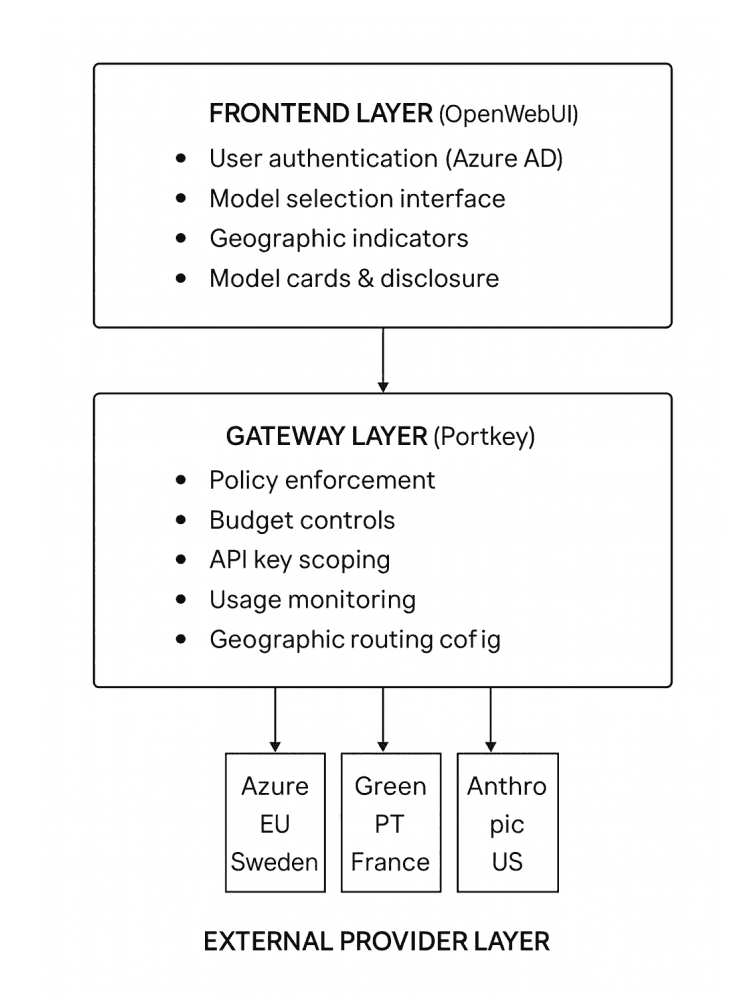
Fontys ICT designed its platform around a simple principle: separate user experience, governance, and model providers, so each can evolve independently without compromising institutional control. Portkey was selected as the gateway layer after evaluating custom-built and alternative options.
The architecture has three distinct layers:
A frontend layer (OpenWebUI) providing a familiar, ChatGPT-style interface tied to institutional identity via single sign-on
A gateway layer (Portkey) translating institutional policy into enforceable rules around access, routing, and budgets
A provider layer connecting to commercial providers, EU-hosted infrastructure (Azure AI Foundry), and self-hosted models
"Earlier, they would always default to ChatGPT. Now, they actually have a choice in terms of an open source model, a locally hosted model, or a commercially provided model"
— Koen Sullen, Msc, AI taskforce, Fontys ICT. Lecturer and researcher
See what Portkey can do for your AI stack
Institutional AI platform with governance and observability
After six months of operations, Fontys ICT validated that universities can offer advanced AI without losing control.With automated failover and real-time performance tracking, SiteGPT can route requests dynamically and maintain service even when individual providers experience latency or rate limits.
EU-first routing works when enforced by default. Most usage stayed within EU-hosted infrastructure. When non-EU models were required, explicit disclosure and access controls ensured cross-border processing was intentional and documented.
Budget controls shaped responsible usage. Spend limits encouraged users to think critically about model choice and cost-performance trade-offs.
Centralized logging and attribution made AI usage understandable at an institutional level, enabling informed decisions about costs, access policies, and future expansion.
Governance became enforceable, not aspirational. Institutional values around equity, transparency, and GDPR compliance were encoded directly into the platform's operation, not layered on as documentation after the fact.
"One of the major advantages that we see is the zero day turnover time in implementing a new model"
— Koen Sullen, Msc, AI taskforce, Fontys ICT. Lecturer and researcher
Lessons for AI teams scaling their operations
Based on Fontys ICT's experience, institutions building governed AI platforms should keep several points in mind.
Treat governance as infrastructure. Encoding rules at the gateway means they apply consistently.
Make model choice explicit and educational. Instead of routing requests invisibly, surfacing model differences (hosting location, cost, capability) reinforces that choosing between AI systems is part of professional practice.
Plan for continuous governance. New models, provider updates, and changing performance characteristics require ongoing evaluation, this is not a one-time setup.
Define clear ownership early. Access approvals and exceptions need clearly defined responsibility as usage grows beyond pilot scale.
If you'd like to see what Portkey can do for you, book a demo with us today.