
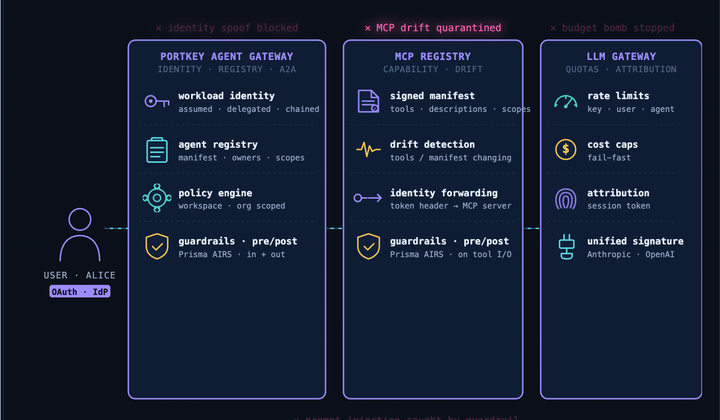
What MCP Governance Actually Means in Production 53% of MCP servers use static API keys. Learn the four governance primitives your team needs to control shadow MCP, credentials, and audit trails in production.
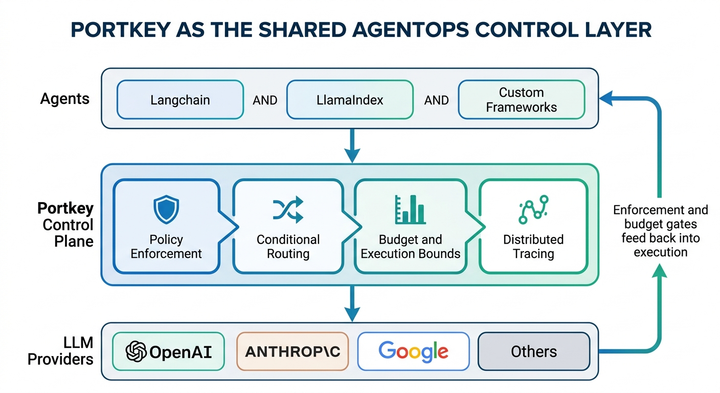
What’s an agent gateway? A 12-step agent run produces the wrong answer. You open the logs and find fifteen 200s. Every individual call succeeded. The agent is technically running but it just ran off the rails somewhere between step 3 and step 12, and nothing in your stack can tell you where. This happens
What is AgentOps? A single LLM call has one shape: request in, response out. You log it, alert on it, and move on. Agents break that model. They make multiple LLM calls per task, decide which tools to invoke, and chain those decisions across steps to reach an outcome. By the time something
GitHub Copilot best practices for teams GitHub Copilot feels simple when a few developers use it. When entire teams depend on it every day, and platform engineers are expected to explain who is using it, how requests are routed, and where usage actually shows up across environments, things start to get complex. At this stage, Copilot
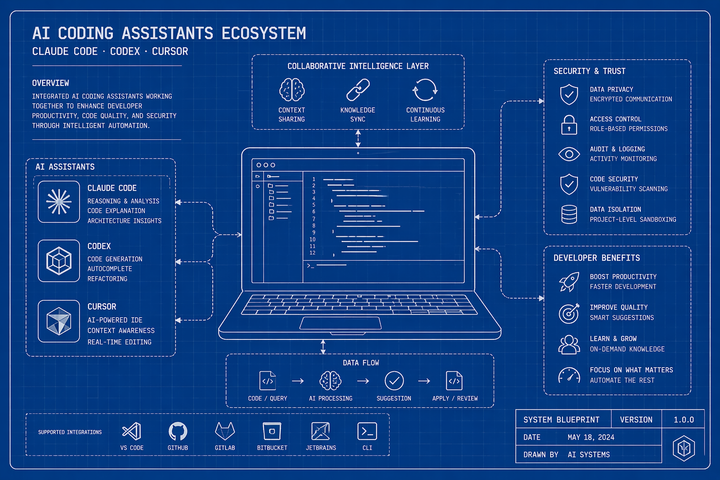
Who owns Claude Code at your company? A platform team's guide to managing coding agents at scale The harness is converging. Context is what separates teams. A platform team's guide to owning Claude Code, Cursor, and Codex across your engineering org.
Introducing Skills Registry coding agents need context to be useful. skills registry lets teams author skills once, review and version them, and sync to claude code, cursor, and codex.
Your First AI Agent Will Go Fine. Your Fiftieth Is Where Things Get Interesting. The first agent is almost always a success story. A well-scoped task, a small team, clear ownership, everyone watching it closely. It works. Leadership gets excited. More agents get approved. And somewhere between agent five and agent fifty, the wheels come off. This is not a warning about AI being
n8n Best Practices n8n works reliably in a single-developer status. The picture changes once AI Agent nodes begin calling LLMs across shared teams and environments. Token usage is hard to track, provider keys are spread across credentials, and workflows depend on a single model endpoint. The gap is not in workflow design. It
OpenAI Codex best practices Codex works well for one developer. The moment it scales to an enterprise team, the operational gaps show up fast: no visibility into who's spending what, API keys scattered across machines with no clean revocation path, no isolation between teams sharing the same provider capacity, and no fallback
AI Agent governance Most teams deploying agents in production are moving faster than their safeguards can keep up. Existing controls were designed for single LLM requests: one prompt in, one response, maybe a content filter at the boundary. Agents don't work that way. They chain model calls, invoke tools, and trigger
Semantic caching thresholds and why they matter Learn how to set semantic caching thresholds, manage TTL, handle multi-turn queries, and monitor silent failures in production LLM apps.
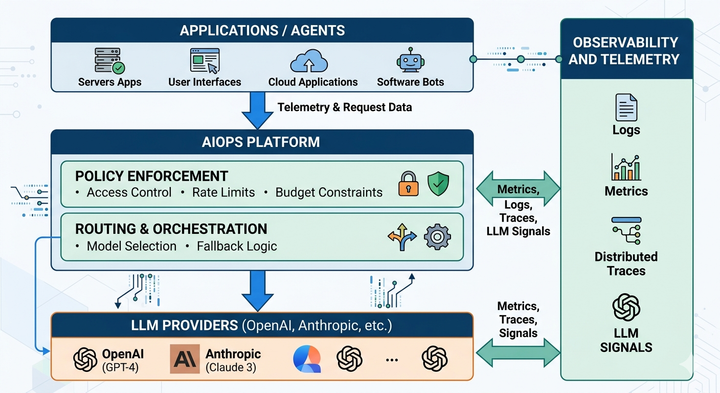
How to choose the right AIOps platform Your AI agent has been routing requests incorrectly, but your dashboards still show green because the infrastructure is healthy. Traditional ops were built for infrastructure systems. They do not account for workloads where correctness depends on prompts, models, and multi-step reasoning. This guide outlines what enterprises should expect from an
Conductor × Portkey is now live In March 2026, Anthropic started throttling Claude Code sessions during peak hours. Max plan users paying $200 a month were burning through their five-hour windows in under 20 minutes. Anthropic confirmed that they were intentionally adjusting session limits to manage growing demand. Conductor is one of the few tools in