

Introduction
Agno is a powerful framework for building autonomous AI agents that can reason, use tools, maintain memory, and access knowledge bases. The AI Gateway enhances Agno agents with production-grade capabilities. The AI Gateway transforms your Agno agents into production-ready systems by providing:- Complete observability of agent reasoning, tool usage, and knowledge retrieval
- Access to 3,000+ LLMs through a unified interface
- Built-in reliability with fallbacks, retries, and load balancing
- Cost tracking and optimization across all agent operations
- Advanced guardrails for safe and compliant agent behaviour
- Governance with budget controls and access management
Agno AI Official Documentation
Learn more about Agno’s agent framework and core concepts
Setting Up the AI Gateway
If this is your first time using the AI Gateway, you will need to connect your LLM Provider in the app to use them in your Agno AI agents.1
Create an Integration
Navigate to the Integrations section on the AI Gateway’s Sidebar. This is where you’ll connect your LLM providers.
- Find your preferred provider (e.g., OpenAI, Anthropic, etc.)
- Click Connect on the provider card
- In the “Create New Integration” window:
- Enter a Name for reference
- Enter a Slug for the integration
- Enter your API Key and other provider specific details for the provider
- Click Next Step
In your next step you’ll see workspace provisioning options. You can select the default “Shared Team Workspace” if this is your first time OR chose your current one.
2
Configure Models
On the model provisioning page: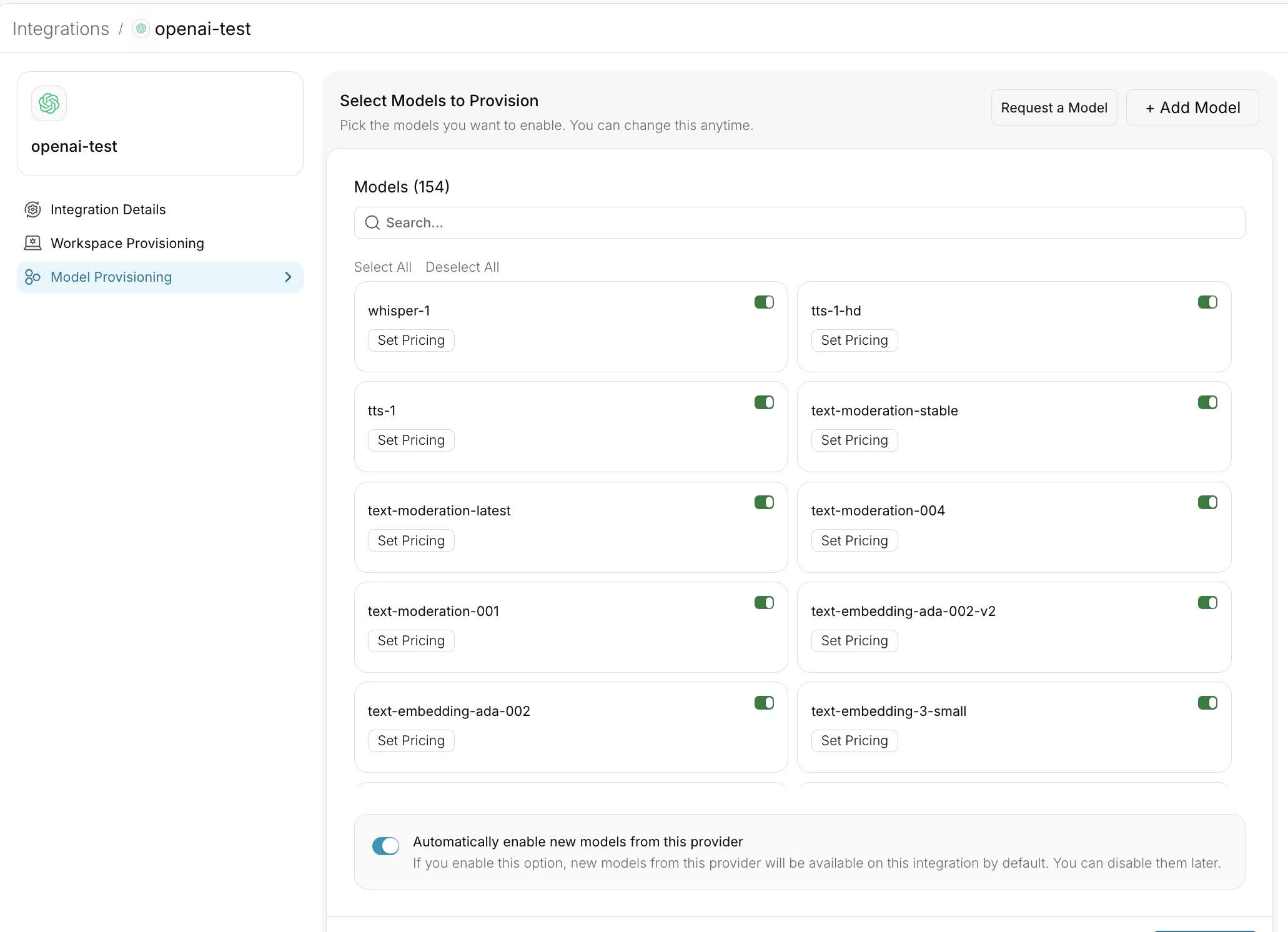
- Leave all models selected (or customize)
- Toggle Automatically enable new models if desired
3
Copy the Provider Slug
Once your Integration is created:
- Go to Model Catalog → AI Providers tab
- Find your integration
- Copy the slug (e.g.,
openai-dev)
This slug is your provider’s unique identifier - you’ll need it for the next step.
Quickstart
You will need- AI Gateway API Key & AI Gateway Provider slug from Step 1
1
Install required packages
2
Get your AI Gateway API Key
Sign up at stratacloudmanager.paloaltonetworks.com to get your API key.Once you are on the AI Gateway follow this guide to create your first AI provider and integration that will help us connect Agno to any LLM provider.
3
Configure the AI Gateway with Agno
Agno makes integration incredibly simple - just use the
OpenAILike model class with the AI Gateway’s configuration:Simple E2E example agent
Let’s create a simple Agno agent that uses the AI Gateway for LLM calls:simple_agent.py
Production Features
1. Enhanced Observability
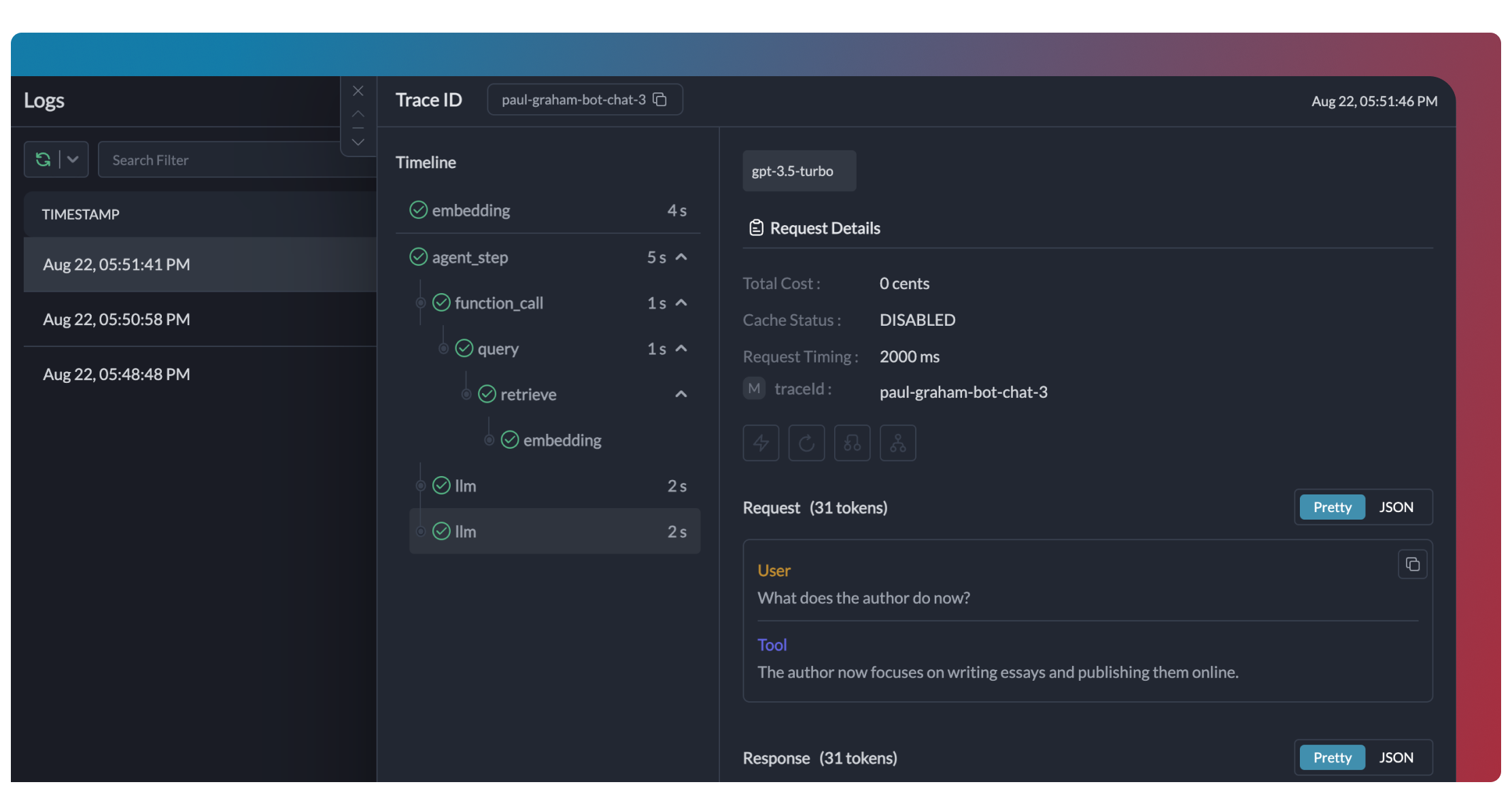
The AI Gateway provides comprehensive observability for your Agno agents, helping you understand exactly what’s happening during each execution.- Traces
- Logs
- Metrics & Dashboards
- Metadata Filtering


2. Reliability - Keep Your Agents Running Smoothly
When running agents in production, things can go wrong - API rate limits, network issues, or provider outages. The AI Gateway’s reliability features ensure your agents keep running smoothly even when problems occur. It’s this simple to enable fallback in your Agno agents:Automatic Retries
Handles temporary failures automatically. If an LLM call fails, the AI Gateway will retry the same request for the specified number of times - perfect for rate limits or network blips.
Request Timeouts
Prevent your agents from hanging. Set timeouts to ensure you get responses (or can fail gracefully) within your required timeframes.
Conditional Routing
Send different requests to different providers. Route complex reasoning to GPT-4, creative tasks to Claude, and quick responses to Gemini based on your needs.
Fallbacks
Keep running even if your primary provider fails. Automatically switch to backup providers to maintain availability.
Load Balancing
Spread requests across multiple API keys or providers. Great for high-volume agent operations and staying within rate limits.
3. Guardrails for Safe Agents
Guardrails ensure your Agno agents operate safely and respond appropriately in all situations. Why Use Guardrails? Agno agents can experience various failure modes:- Generating harmful or inappropriate content
- Leaking sensitive information like PII
- Hallucinating incorrect information
- Generating outputs in incorrect formats
- Detect and redact PII in both inputs and outputs
- Filter harmful or inappropriate content
- Validate response formats against schemas
- Check for hallucinations against ground truth
- Apply custom business logic and rules
Learn More About Guardrails
Explore the AI Gateway’s guardrail features to enhance agent safety
4. User Tracking with Metadata
Track individual users through your Agno agents using the AI Gateway’s metadata system. What is Metadata in the AI Gateway? Metadata allows you to associate custom data with each request, enabling filtering, segmentation, and analytics. The special_user field is specifically designed for user tracking.
Filter Analytics by User
With metadata in place, you can filter analytics by user and analyze performance metrics on a per-user basis:

Filter analytics by user
- Per-user cost tracking and budgeting
- Personalized user analytics
- Team or organisation-level metrics
- Environment-specific monitoring (staging vs. production)
Learn More About Metadata
Explore how to use custom metadata to enhance your analytics
5. Caching for Efficient Agents
Implement caching to make your Agno agents more efficient and cost-effective:- Simple Caching
- Semantic Caching
6. Model Interoperability: using different LLMs
One of the AI Gateway’s key strengths is providing access to 3,000+ LLMs through a unified interface. Here’s how to use different providers with Agno:Supported Providers
See the full list of LLM providers supported by the AI Gateway
- OpenAI
- Anthropic
- Google
End-to-End Examples
Level 1: Agent with Tools and Observability
Let’s build an agent that uses tools while leveraging the AI Gateway’s observability features:Level 2: Agent with Knowledge Base and Caching
Enhance your Agno agent with knowledge retrieval while using the AI Gateway’s caching to optimize costs:Level 3: Agent with Memory, Reasoning, and Reliability
Build a sophisticated agent that leverages Agno’s advanced features with the AI Gateway’s reliability configurations:advanced_agent.py
Set Up Governance for Agno AI agents
Why Governance? If you are using Agno AI agents inside your orgnaization, you need to consider several governance aspects:- Cost Management: Controlling and tracking AI spending across teams
- Access Control: Managing which teams can use specific models
- Usage Analytics: Understanding how AI is being used across the organisation
- Security & Compliance: Maintaining your organisation’s security standards
- Reliability: Ensuring consistent service across all users
Step 1: Implement Budget Controls & Rate Limits
Step 1: Implement Budget Controls & Rate Limits
Step 1: Implement Budget Controls & Rate Limits
Model Catalog enables you to have granular control over LLM access at the team/department level. This helps you:- Set up budget limits
- Prevent unexpected usage spikes using Rate limits
- Track departmental spending
Setting Up Department-Specific Controls:
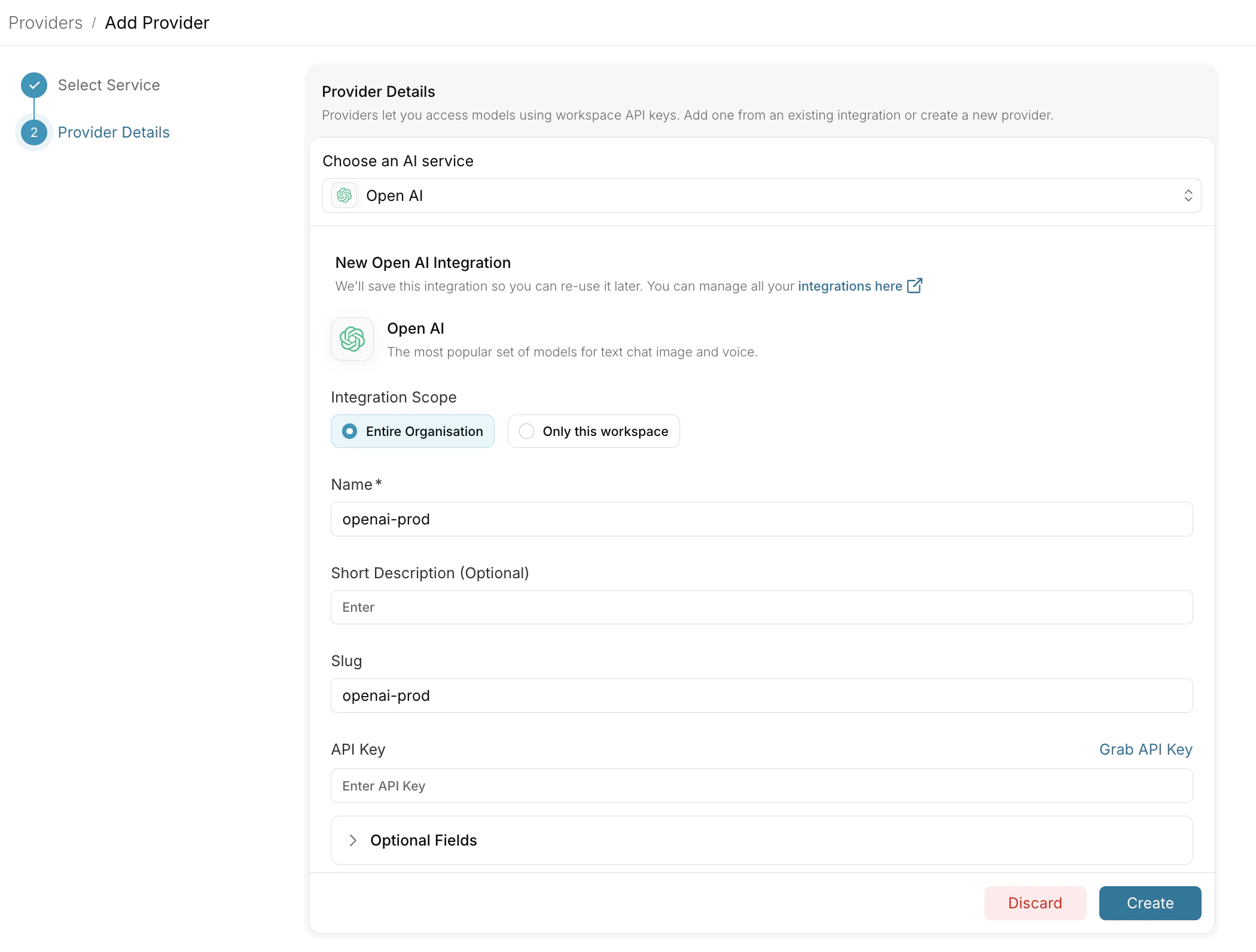
- Navigate to Model Catalog in Strata Cloud Manager
- Create new Provider for each engineering team with budget limits and rate limits
- Configure department-specific limits
Step 2: Define Model Access Rules
Step 2: Define Model Access Rules
Step 2: Define Model Access Rules
As your AI usage scales, controlling which teams can access specific models becomes crucial. You can simply manage AI models in your org by provisioning model at the top integration level.Step 4: Set Routing Configuration
Step 4: Set Routing Configuration
The AI Gateway allows you to control your routing logic very simply with it’s Configs feature. AI Gateway Configs provide this control layer with things like:Create your config on the Configs page in Strata Cloud Manager. You’ll need the config ID for connecting your Agno agents.
- Data Protection: Implement guardrails for sensitive code and data
- Reliability Controls: Add fallbacks, load-balance, retry and smart conditional routing logic
- Caching: Implement Simple and Semantic Caching. and more…
Example Configuration:
Here’s a basic configuration to load-balance requests to OpenAI and Anthropic:Configs can be updated anytime to adjust controls without affecting running applications.
Step 4: Implement Access Controls
Step 4: Implement Access Controls
Step 3: Implement Access Controls
Create User-specific API keys that automatically:- Track usage per developer/team with the help of metadata
- Apply appropriate configs to route requests
- Collect relevant metadata to filter logs
- Enforce access permissions
Step 5: Deploy & Monitor
Step 5: Deploy & Monitor
Step 4: Deploy & Monitor
After distributing API keys to your engineering teams, your Agno setup is ready to go. Each developer can now use their designated API keys with appropriate access levels and budget controls. Apply your governance setup using the integration steps from earlier sections Monitor usage in Strata Cloud Manager:- Cost tracking by engineering team
- Model usage patterns for AI agent tasks
- Request volumes
- Error rates and debugging logs
What’s Available
Agno AI agents now has:- Departmental budget controls
- Model access governance
- Usage tracking & attribution
- Security guardrails
- Reliability features
Frequently Asked Questions
How does the AI Gateway enhance my Agno agents?
How does the AI Gateway enhance my Agno agents?
The AI Gateway adds production-grade features to Agno agents including comprehensive observability (traces, logs, analytics), reliability (fallbacks, retries, load balancing), access to 3,000+ LLMs, cost management, and governance - all without changing your agent logic.
Can I use any LLM with Agno through the AI Gateway?
Can I use any LLM with Agno through the AI Gateway?
Yes! The AI Gateway provides access to 3,000+ LLMs from providers like OpenAI, Anthropic, Google, Cohere, and many more. Just change the model ID in your configuration to switch between providers.
How do I track costs for different agents?
How do I track costs for different agents?
The AI Gateway automatically tracks costs for all LLM calls. You can segment costs by agent type, user, or custom metadata. Set up AI Provider integrations with budget limits to control spending on Model Catalog.
Does Palo Alto Networks support all Agno features?
Does Palo Alto Networks support all Agno features?
Yes! The AI Gateway works seamlessly with all Agno features including tools, reasoning, memory, knowledge bases, and storage. It adds observability and reliability without limiting any Agno functionality.
How do I debug agent failures?
How do I debug agent failures?
The AI Gateway’s detailed logs and traces make debugging easy. You can see the complete execution flow, including failed tool calls, LLM errors, and retry attempts. Filter by trace ID or metadata to find specific issues.
Resources
Agno Documentation
Learn more about building agents with Agno
AI Gateway Features
Explore all AI Gateway capabilities